
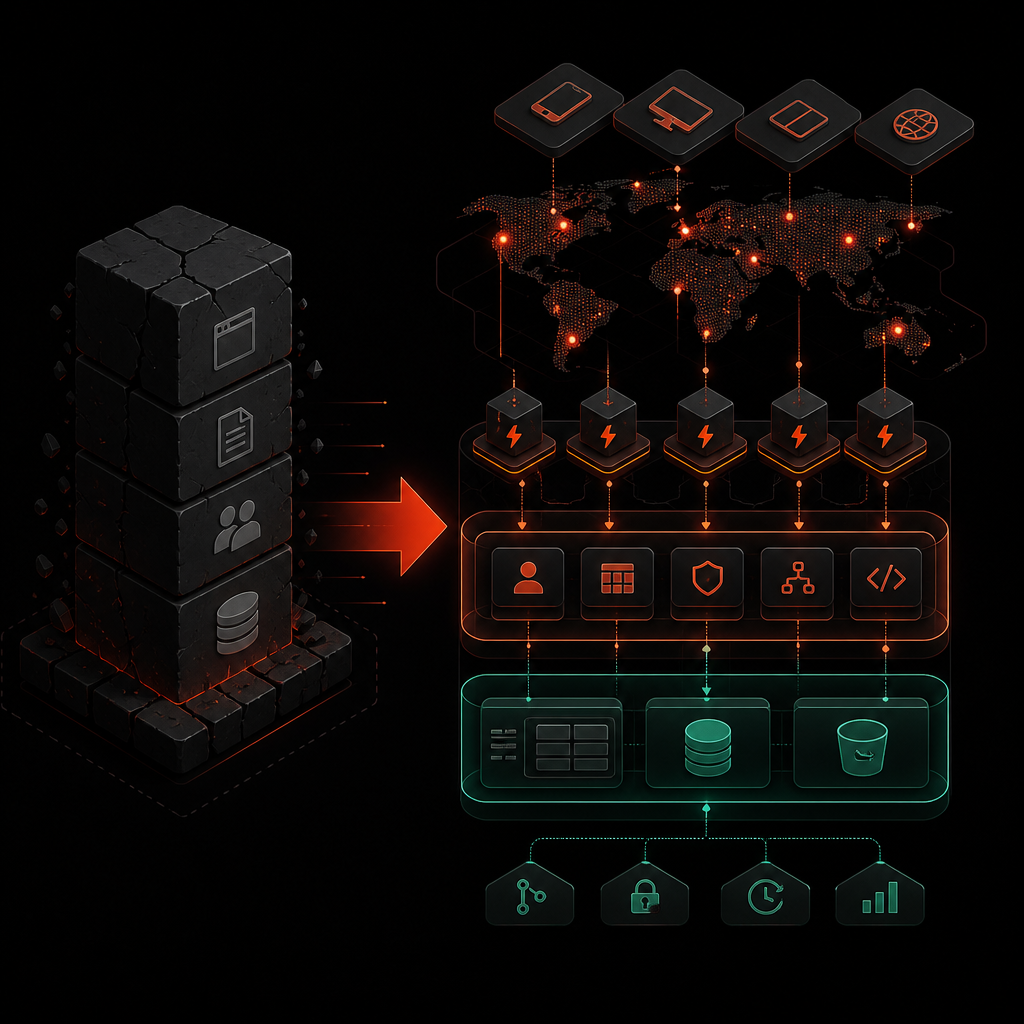

Beyond WordPress: Why Modern Businesses Are Migrating to Next.js 16 and Supabase
For more than a decade, WordPress was the default choice for building corporate websites and web platforms. It offered an accessible entry point: low upfront capital, thousands of plug-and-play themes, and an interface non-technical teams could manage without writing code.
By 2026, the digital landscape has fundamentally shifted. Modern digital businesses no longer compete solely on visual polish—they compete on Core Web Vitals, edge latency, zero-trust security postures, and engineering velocity.
For companies scaling past early traction, the traditional WordPress stack introduces crippling operational bottlenecks: plugin dependency debt, sluggish mobile rendering, recurring security vulnerabilities, and unpredictable hosting bills.
At Kreasi Kita, we engineer web systems using a modern, decoupled stack: Next.js 16 (App Router + React 19) paired with Supabase (PostgreSQL + RLS).
Here is an architectural, operational, and financial analysis of why growing businesses are leaving legacy CMS architectures behind for custom Next.js 16 and Supabase.
1. The Monolithic Trap: How Legacy CMS Breaks Down at Scale
To understand why modern engineering teams migrate away from legacy CMS setups, look at how WordPress processes a single HTTP request:
User Request -> Apache / Nginx -> PHP-FPM Process Pool -> WordPress Core -> Plugin Hooks (30-50+) -> MySQL Relational Query (Uncached) -> HTML Assembly -> Network Response
Every page view triggers dynamic server evaluation across dozens of plugin filters and database lookups. To mask this latency, developers layer on caching plugins (WP Rocket, W3 Total Cache, Redis caches, Cloudflare APO).
While caching plugins mask symptoms on static visits, they break down immediately under dynamic conditions: personalized user dashboards, multi-currency checkouts, gated lead magnets, or high-concurrency campaigns.
The True Cost of Plugin Dependency
A typical production WordPress site relies on 25 to 50 active plugins to handle basic enterprise functionality:
- Advanced Custom Fields (ACF Pro) for data modeling
- Yoast or RankMath for metadata and XML sitemaps
- Wordfence or Sucuri for intrusion detection
- WPML or Polylang for multi-language routing
- Form handlers, backup managers, analytics wrappers, and performance boosters
Every third-party plugin represents an unvetted code dependency running with full administrative privileges inside your server runtime. One incompatible update can break your sales funnel; one abandoned plugin creates an open vulnerability for automated exploits.
2. Performance: Next.js 16 App Router vs. Monolithic PHP
Google's search indexing algorithms strictly enforce Core Web Vitals (CWV)—specifically Largest Contentful Paint (LCP), Interaction to Next Paint (INP), and Cumulative Layout Shift (CLS). Faster load times directly translate into lower bounce rates and higher conversion rates.
| Architectural Dimension | Legacy WordPress + Theme Builder | Next.js 16 + Supabase Architecture |
|---|---|---|
| Rendering Strategy | Server-Side PHP execution per request | Partial Prerendering (PPR) + React Server Components (RSC) |
| Global Edge Delivery | Reverse-proxy cache (stale or uncached) | Native Edge deployment across 300+ CDN nodes (Vercel / Cloudflare) |
| Typical Mobile LCP | 3.2s – 5.5s (Heavy CSS/JS bloat) | 0.8s – 1.4s (Zero client JS for static server components) |
| Interaction to Next Paint (INP) | High latency due to DOM re-evaluations | Sub-50ms via fine-grained React 19 transitions |
| Database Access | Repetitive SQL queries via wp_posts | Edge-optimized Supabase connection pooler (Supavisor) |
| Asset Optimization | External plugins with manual webp conversion | Native next/image with AVIF/WebP on-demand optimization |
Why Next.js 16 Wins on Edge Performance
Next.js 16 takes rendering performance further with three architectural pillars:
- React Server Components (RSC): Traditional client-heavy frameworks ship massive JavaScript bundles to the browser. In Next.js 16, markdown parsers, heavy utility libraries, and data fetching logic stay strictly on the server. The client receives clean, lightweight HTML, slashing bundle sizes by up to 70%.
- Partial Prerendering (PPR): You no longer have to choose between fully static (SSG) or fully dynamic (SSR) pages. Next.js 16 serves a pre-rendered static shell instantly from the nearest edge cache while streaming personalized or dynamic components in parallel without blocking initial paint.
- Turbopack Compiler: Lightning-fast build times enable rapid CI/CD deployment cycles, eliminating multi-minute build pipelines during continuous releases.
When every millisecond of latency reduction yields measurable conversion uplifts (typically 7–10% per 100ms improvement according to enterprise web benchmarks), custom Next.js 16 architectures pay for themselves in customer acquisition efficiency alone.
3. Security: Eliminating the Attack Surface
According to Sucuri's annual web threat research, over 94% of CMS-based infections originate from WordPress sites, with 98% of those breaches stemming from third-party plugins and themes rather than core engine flaws.
The Attack Surface Comparison
- WordPress: Exposes well-known public entry points (
/wp-login.php,/wp-json/wp/v2/,xmlrpc.php). Attackers deploy automated botnets searching for outdated plugins, directory traversal flaws, and SQL injections 24/7. - Next.js 16 + Supabase: The public frontend is served as immutable static assets and secured edge functions. There is no exposed administrative portal, no open PHP interpreter, and no direct database port reachable from the public internet.
[Public Visitor]
      │
      ▼ (HTTPS)
[Global Edge CDN (Next.js 16)]
      │
      ▼ (Server Action / HTTPS via TLS 1.3)
[Supabase Backend (PostgreSQL)] ───► Protected by Row-Level Security (RLS)
PostgreSQL Row-Level Security (RLS)
In legacy CMS databases, security is handled at the application layer: if a PHP script has a bug, the entire database is readable.
Supabase handles security directly inside the PostgreSQL kernel using Row-Level Security (RLS):
-- Example: Strict RLS policy on sensitive client leads
alter table public.leads enable row level security;

create policy "Admins can view all leads"
on public.leads
for select
to authenticated
using (auth.jwt() ->> 'role' = 'agency_admin');

create policy "Public can only insert leads"
on public.leads
for insert
to anon
with check (true);
Even if an attacker attempts unauthorized requests against the API, the database engine itself rejects the query before data leaves storage.
4. Scalability: Handling Real-World Traffic Spikes
A common nightmare for marketing leaders running product launches, PR campaigns, or paid ad blitzes on WordPress is the dreaded 504 Gateway Timeout or Error Establishing a Database Connection.
When sudden spikes hit a standard VPS or shared hosting plan:
- PHP worker processes saturate available CPU cores within seconds.
- MySQL exhausts maximum allowed connections (
max_connectionsreached). - Apache or Nginx worker threads drop incoming HTTP requests.
The Serverless Edge Advantage
With Next.js 16 and Supabase:
- Frontend Traffic: Served via globally distributed serverless edge networks. If a marketing campaign drives 100,000 visitors in fifteen minutes, serverless workers spin up instantly across global regions. No single VPS CPU throttles; no downtime occurs.
- Database Concurrency: Supabase utilizes Supavisor, a high-performance connection pooler capable of managing millions of concurrent connections to PostgreSQL without memory starvation.
- Edge Functions: Dynamic tasks (lead capture, email triggering, webhook ingestion) run in isolated V8 isolates with cold start times under 10 milliseconds.
5. Business ROI: 3-Year Total Cost of Ownership (TCO)
While WordPress appears cost-effective on day one, the 3-year total cost of ownership tells a completely different financial story.
3-Year Cost Comparison Breakdown (Growing Business)
| Cost Category | Managed WordPress Stack | Next.js 16 + Supabase Stack |
|---|---|---|
| Year 1 Build & Setup | $2,000 – $5,000 (Theme customization) | $4,500 – $9,000 (Custom architecture) |
| Hosting & Infrastructure | $1,200 – $3,600 (Dedicated WP hosting e.g., WP Engine/Kinsta) | $300 – $600 (Vercel Pro + Supabase Pro tiers) |
| Plugin Subscriptions | $1,500 – $3,000 (ACF, WPML, Elementor, Security, Backups) | $0 (Bespoke code, zero recurring plugin fees) |
| Maintenance & Patching | $3,600 – $7,200 (Emergency bug fixes, plugin conflict resolutions) | $600 – $1,200 (Stable CI/CD, minimal routine upkeep) |
| Lost Revenue from Downtime & Sluggish LCP | High (5–15% conversion penalty on mobile visitors) | Minimal (Reliable 99.99% uptime, sub-second LCP) |
| Total Estimated 3-Year TCO | $12,000 – $22,000+ | $8,000 – $14,000 |
Building on Next.js 16 and Supabase transforms website expenses from an ongoing reactive maintenance liability into a durable, compounding software asset.
6. Migration Roadmap: How Kreasi Kita Transitions Clients
Migrating away from WordPress does not require shutting down operations or losing historical SEO equity. Our migration framework follows a structured, zero-downtime path:
- Content & Data Extraction: We extract all existing articles, media files, user records, and custom post types via WP REST API or direct SQL export into structured JSON schemas.
- PostgreSQL Schema Architecture: We normalize and structure data inside Supabase, establishing optimized indexes, foreign keys, and strict Row-Level Security policies.
- Tailored Next.js 16 Frontend Rebuild: We design custom, brand-aligned user experiences using Tailwind CSS, fluid animations, and React Server Components.
- Complete SEO Preservation: We map 301 redirect trees for all historical URLs, preserve canonical tags, and implement structured JSON-LD Schema markup to ensure search rankings remain intact or improve.
- Zero-Downtime DNS Cutover: Once end-to-end automated testing passes, DNS traffic points to the new edge CDN with zero user disruption.
Conclusion: Upgrade Your Infrastructure for the Long Term
If your company runs a low-traffic personal blog where page speed and security risks have little commercial impact, WordPress remains an acceptable tool.
However, if your website is the primary growth engine for your company—driving leads, sales, customer interactions, and brand authority—relying on a decade-old PHP template architecture creates compounding operational risk.
Modern businesses choose Next.js 16 and Supabase because they deliver:
- Sub-second performance that satisfies Core Web Vitals and lifts conversion rates.
- Hardened security that eliminates third-party plugin attack vectors.
- Elastic scalability that never fails during peak marketing campaigns.
- Predictable TCO with zero recurring plugin licensing traps.
Ready to modernize your web architecture? Contact the engineering team at Kreasi Kita to schedule a technical architecture and performance audit of your current platform.