
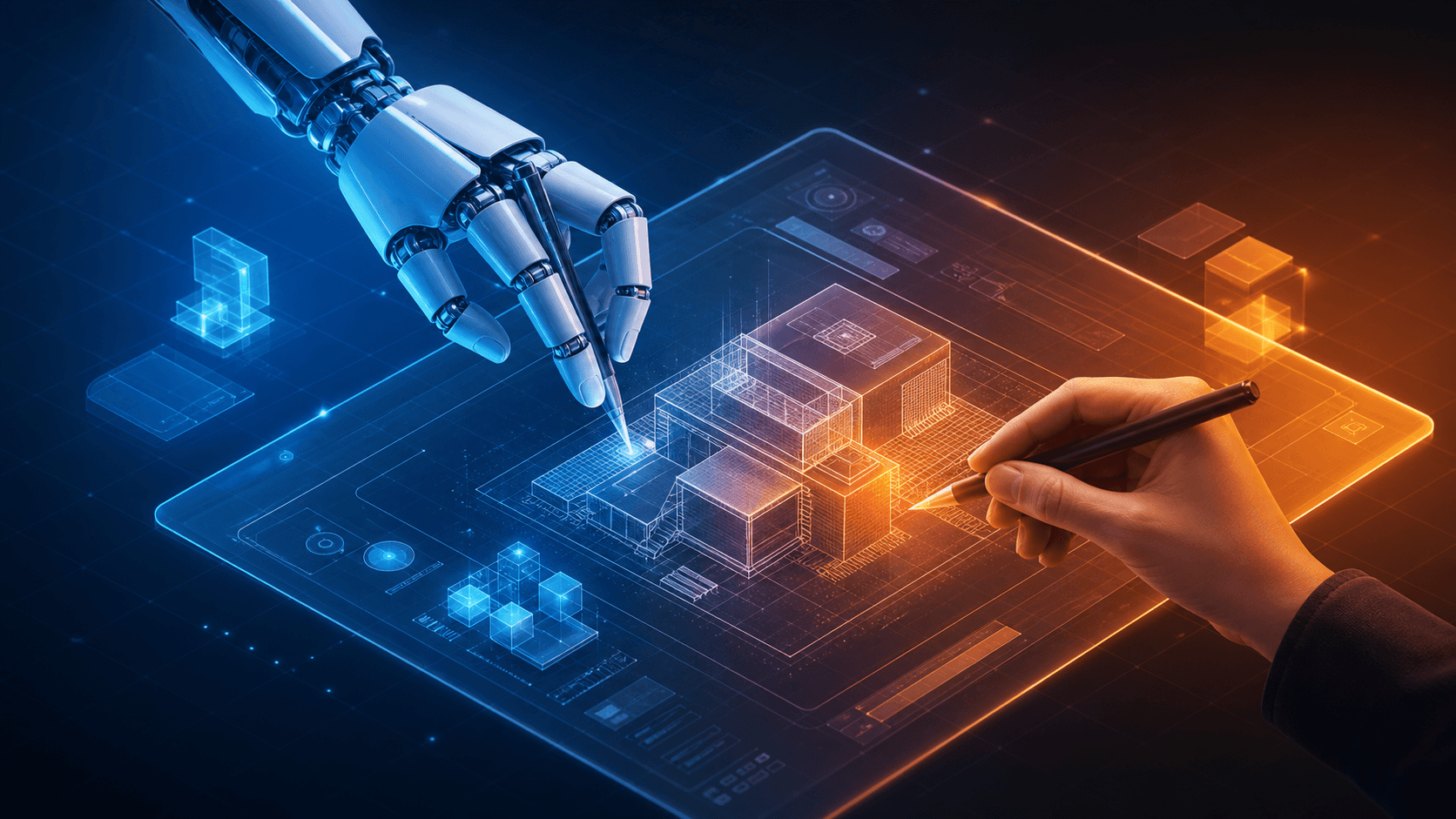

The Impact of AI on the Web Design Industry: Opportunity or Threat?
AI is no longer a future trend in digital design. It is already changing how websites are planned, designed, written, tested, and optimized. For agency owners and business leaders, the big question is not whether AI will affect the industry. It already has. The real question is this: is AI in web design an opportunity to move faster and smarter, or a threat to creative quality and human expertise?
The honest answer is both, depending on how it is used.
Today, tools like Midjourney, Figma AI, and V0.dev can generate ideas, layouts, components, and even front-end code in minutes. AI can also support personalization, automate repetitive tasks, and speed up production dramatically. At the same time, many people worry that design will become generic, strategy will be ignored, and designers will be replaced by machines.
But that fear misses an important point. AI is not removing the need for designers. It is changing what designers should focus on. The value is shifting away from manual production and toward strategy, creative direction, brand thinking, and deeper UX problem-solving.
Let’s look at what is really happening.
How AI Is Changing the Web Design Workflow
The most visible impact of AI is speed. Tasks that once took hours or days can now be done in minutes. That does not mean the final result is automatically better, but it does mean the workflow is evolving fast.
Faster concept generation
Tools like Midjourney have changed the early ideation phase. Designers and agencies can create moodboards, visual directions, illustration styles, and campaign concepts much faster than before. Instead of starting from a blank page, teams can explore multiple creative directions quickly and use them as a discussion tool with clients.
This is especially useful in the discovery stage, where speed matters. A business owner can react to visual possibilities earlier, and a design team can validate whether a direction feels premium, playful, minimal, or bold before spending too much time polishing it.
Smarter interface design with Figma AI
Figma AI is helping designers streamline day-to-day work inside the design process. From generating copy placeholders to organizing layers, suggesting layouts, and accelerating wireframing, it reduces repetitive tasks that used to slow teams down.
For agencies, this can improve efficiency across multiple projects. For in-house teams, it can free up time for more meaningful design decisions. The real advantage is not just automation. It is the ability to spend less energy on production mechanics and more energy on solving user and business problems.
Rapid prototyping with V0.dev and AI-generated code
V0.dev and similar tools are pushing AI further into the build stage. They can turn prompts into UI sections, landing page structures, and front-end code prototypes surprisingly fast. This is useful for testing ideas, building MVPs, and helping non-technical stakeholders visualize a concept.
For startups and businesses that need to move quickly, this can be a huge advantage. Instead of waiting weeks to see a working direction, teams can validate ideas much earlier.
However, fast output is not the same as thoughtful design. AI-generated layouts often look clean and modern, but they can still miss business context, content hierarchy, accessibility details, and conversion logic.
The Real Opportunities of AI in Web Design
When used well, AI in web design creates real business value. It is not just about saving time. It can improve experimentation, personalization, and scalability.
More efficient production
Agencies can use AI to handle repetitive work such as wireframe drafts, content suggestions, image exploration, alt text generation, and design variations. This reduces turnaround time and allows teams to take on more strategic work without increasing headcount at the same pace.
For business owners, this can mean faster launches, more iterations, and lower production friction.
Better personalization at scale
One of the most exciting areas is AI-powered personalization. Websites are no longer limited to a one-size-fits-all experience. AI can help tailor product recommendations, content blocks, CTAs, and user journeys based on behavior, preferences, location, or intent.
That matters because modern users expect relevance. A returning visitor should not always see the same message as a first-time visitor. A B2B prospect may need a different path than a consumer buyer. AI can help websites adapt more intelligently.
When personalization is done well, it can improve engagement, conversion rates, and customer experience. For agencies, this opens up new service opportunities beyond visual design alone.
Faster testing and iteration
AI also supports a more agile design process. Teams can generate multiple layout options, content versions, or UI patterns quickly, then test what performs better. Instead of debating endlessly about design preferences, businesses can validate choices with real user data.
This creates a healthier workflow where design is not just about aesthetics, but about measurable outcomes.
The Risks: Where AI Can Become a Threat
AI brings efficiency, but it also creates new problems if used carelessly. The threat is not AI itself. The threat is shallow implementation.
Generic design is becoming easier to produce
One major risk is sameness. If everyone uses the same prompts, the same tools, and the same generated components, websites start to look alike. They may feel polished, but not distinctive.
That is dangerous for brands that need to stand out in crowded markets. A website should not only function well. It should also communicate identity, trust, and positioning. AI can imitate patterns, but it does not naturally create a meaningful brand point of view.
Strategy can get overlooked
Because AI makes production feel easy, some teams may skip the strategic foundation. They jump straight into layouts without fully understanding the audience, user goals, brand story, or business model.
This is where many AI-first outputs fall short. A website is not just a collection of sections. It is a business tool. Without strategy, even a visually attractive AI-generated site can fail to convert.
Overreliance can weaken creative judgment
Another risk is dependency. If designers rely too heavily on AI suggestions, they may stop questioning whether a solution is actually right. AI can offer options, but it does not replace critical thinking.
Good design often comes from tension, insight, and intentional trade-offs. Those are human skills. If teams blindly accept AI output, quality may decline even while speed increases.
What Still Needs Human Designers
This is the most important part of the conversation. AI can assist many tasks, but it still cannot replace the deeper human layers of design work.
Brand strategy
A strong brand is built on positioning, values, audience understanding, and differentiation. AI can generate visual styles, but it cannot truly define what a brand should stand for in a competitive market.
That requires human judgment, business understanding, and strategic alignment. Agencies that can connect branding with digital execution will remain highly valuable.
Emotional design
People do not connect with websites only because they are functional. They connect because something feels trustworthy, premium, exciting, clear, or memorable. Emotional design is about nuance.
A human designer understands cultural context, tone, storytelling, and subtle visual choices that create an emotional response. AI can remix patterns, but it does not genuinely feel what users feel.
Complex UX research
AI can analyze data, summarize interviews, and suggest patterns. But deep UX research still needs human interpretation. Understanding why users hesitate, what they fear, how they make decisions, and where friction really comes from is not just a data exercise.
It involves observation, empathy, and asking better questions. Especially for complex websites, enterprise platforms, or high-stakes customer journeys, human-led research remains essential.
Creative direction and decision-making
Perhaps the biggest shift is this: designers are becoming directors, not just makers. Instead of manually creating every asset from scratch, they guide systems, shape concepts, evaluate outputs, and make higher-level decisions.
That is not a downgrade. It is an evolution.
So, Opportunity or Threat?
For web design agencies and business owners, AI should be seen as a competitive tool, not a creative replacement. The agencies that struggle will likely be the ones that only sell execution. The agencies that grow will be the ones that combine AI efficiency with human strategy, original thinking, and business insight.
In other words, AI in web design is an opportunity if you use it to enhance expertise. It becomes a threat only when you treat speed as a substitute for quality.
The future of web design will likely look like this:
- AI handles repetitive and scalable tasks
- Designers focus more on strategy and creative direction
- Developers use AI to accelerate prototyping and implementation
- Businesses expect faster delivery, but also smarter digital experiences
- The winning teams are the ones that balance automation with human judgment
That balance is what matters most.
Final Thoughts
AI is reshaping the web design industry, but it is not making human creativity irrelevant. If anything, it is making strategic thinking more valuable than ever. Businesses still need websites that reflect their brand, connect emotionally, and support real user needs. Those outcomes cannot be generated by prompts alone.
If you are an agency owner, this is the time to rethink your service model. If you are a business owner, this is the time to ask not just how fast a website can be built, but how well it can support your brand and growth.
At kreasikita.co, we believe the best digital work happens when technology and human insight work together. If you are exploring how AI and modern web design can support your business, we would be happy to help you build something that is both efficient and meaningful.